
Hundreds of people gathered outside the Whitfield County Courthouse in Georgia in late June 2026 to see what their neighbors had buried 50 years earlier.
Back in 1976, during America’s Bicentennial celebrations, local families had contributed letters, keepsakes, and other belongings to a time capsule sealed beneath the courthouse sidewalk.
Nobody knew exactly what they would find when county workers finally lifted the heavy concrete lid.
As it turned out, water had beaten them to it.
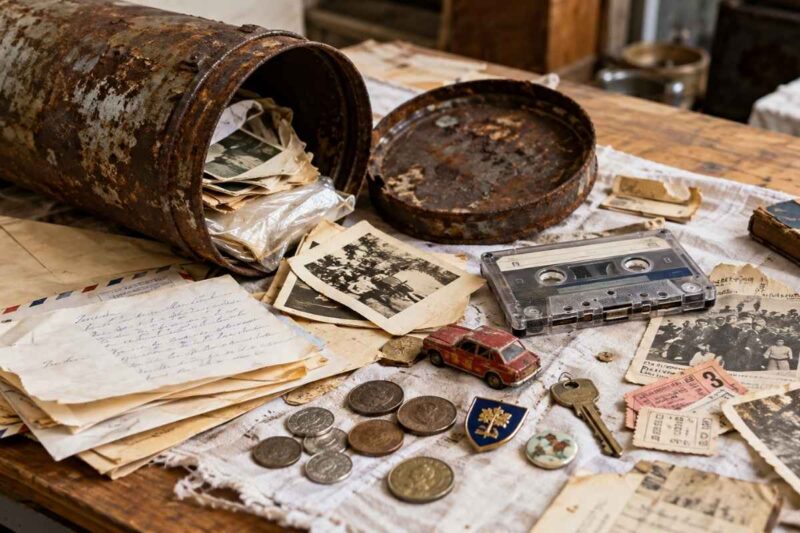
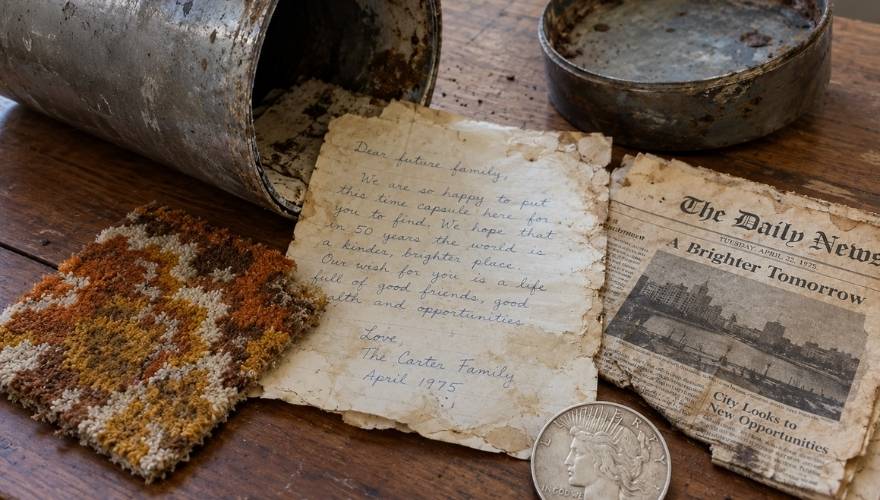
Inside were bags filled with damp envelopes, old newspapers, coins, and a piece of 1970s carpeting that had apparently spent the past half-century developing its own ecosystem.
Fortunately, not everything had suffered.
Among the recovered belongings was an 1881 silver dollar and something considerably more personal: a letter written by a father who had died 24 years earlier.
For all the effort people put into preserving history, a time capsule found decades later rarely delivers exactly what its creators expected.
Sometimes, the most interesting discovery is something nobody thought particularly important when it went underground.
Georgia’s 1976 Time Capsule – Wet Papers, Old Carpet, and a Family Letter
Preparations began in May 1976, when the Dalton Exchange Club invited families in Whitfield County to participate in a community time capsule commemorating the nation’s 200th birthday.
In 1976, President Gerald Ford opened a Centennial Safe that had been sealed at the U.S. Capitol in 1876, exactly 100 years earlier. Whitfield County’s contribution was considerably more modest, although asking residents to put up $5 for a message to the future gave ordinary families a personal stake in the occasion.
For that amount, residents could place personal belongings inside a concrete vault near the courthouse, knowing they wouldn’t be opened for another 50 years.
Some chose newspapers, calendars, and coins. Others contributed handwritten messages addressed to family members.
One person apparently decided future generations needed to see a sample of 1970s carpeting.
An 1881 silver dollar was in considerably better condition.
According to the original reporting on the 2026 opening, Matt Gramling, director of the Bandy Heritage Center, identified the coin and carpeting among the more striking discoveries.
Still, neither object carried quite the emotional weight of a letter recovered by Todd Looper.
A Letter That Outlived Its Writer
Their message expressed hopes for the boys’ futures.
Harry finished by telling his sons he loved them and looked forward to having grandchildren.
At the time, those were ordinary words written by a father imagining the years ahead.
Harry died in 2002.
When the time capsule opened after 50 years in 2026, Todd was able to recover a message his father had written when he was a little boy.
Even his mother couldn’t remember exactly what she had contributed to the capsule.
Such forgetfulness is understandable after five decades. Families move, children grow up, and little details disappear into the ordinary business of living.
Yet there was Harry’s message, waiting beneath a courthouse sidewalk.
An old silver dollar might interest a collector. For Todd, a letter carrying his late father’s words offered something money couldn’t easily replace.
The Strange, Ordinary Things People Think Are Worth Preserving
Choosing what belongs in a time capsule is harder than it sounds.
Important historical events are already recorded in newspapers, photographs, and government documents. Everyday experiences are much easier to overlook.
Some communities have answered the question by saving practically everything.
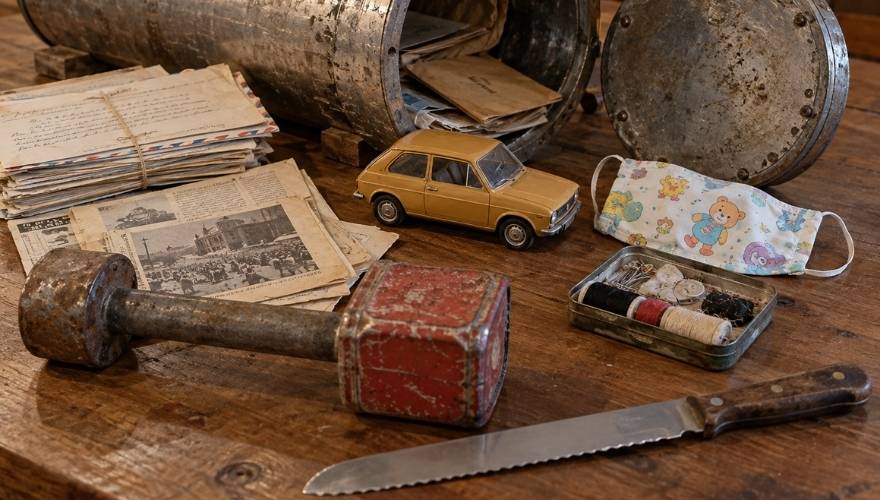
A time capsule dedicated in Seward, Nebraska, in 1975 held approximately 5,000 objects, including an entire Chevrolet Vega. Its concrete vault weighed roughly 45 tons. Apparently, somebody decided future generations deserved to see a family car along with the usual letters and newspaper clippings.
Apparently, somebody decided future generations deserved to see a family car along with the usual letters and newspaper clippings.
In December 2020, BBC Future took a different approach, assembling a virtual time capsule of 37 suggested objects with contributions gathered alongside the School of International Futures.
Several choices were wonderfully practical.
Cartoon-covered children’s face masks captured a period when even young children became accustomed to covering their faces in public.
A needle and thread represented the improvisation involved in making protective equipment when supplies were scarce.
Amy Charles and her housemate Eleanor took improvisation a little further.
Unable to continue their normal exercise routines, they used cement, sand, plumbing pipe, and a lunchbox to create a homemade exercise weight.
Finished weight: 5 kilograms, or approximately 11 pounds. It wasn’t particularly elegant, but it did the job. It could also function as a doorstop, which is more than most gym equipment can claim.
Another contributor suggested a breadknife to capture the sourdough-baking craze that accompanied lockdowns.
Elsewhere, Griesham Taan nominated Hendrix, his 17-year-old mountain bike, which he had retrieved after years in his father’s shed. Perhaps the strangest suggestion was a plastic hug curtain, a protective barrier designed to let relatives embrace while limiting direct contact.
Under ordinary circumstances, such a contraption might have seemed excessive.
In 2020, it made perfect sense to people who had spent months unable to hug their families. None of these items was actually buried as part of the virtual project. They were proposed objects intended to represent the year. Yet the exercise raised much the same question as Georgia’s 1976 capsule.
What will somebody living 50 years later find surprising about the things we consider normal? A homemade cement weight tells a story about closed gyms and household ingenuity. An old carpet sample tells us something about local tastes in interior decorating. Neither would usually earn a place in a history textbook.
Both can explain everyday life remarkably well.
When Time Capsules Don’t Go According to Plan
Opening a time capsule sounds straightforward.
Locate the container, remove the lid, and examine the contents.
Whitfield County’s Public Works crews discovered an additional step: dealing with 50 years of water intrusion.
Standing water had accumulated at the bottom of the concrete vault. Trash bags contained wet envelopes and other damaged belongings.
Georgia wasn’t the only place where an old time capsule caused trouble.
In August 2023, West Point opened a nearly 200-year-old lead box believed to have been placed by military academy cadets around 1828 or 1829.
Initial results were disappointing. Instead of historic documents or military memorabilia, the container appeared to hold nothing but sediment.
A closer examination changed that.
According to the Associated Press report on the discovery, investigators eventually recovered six American silver coins dated between 1795 and 1828, along with an 1826 Erie Canal commemorative medal.
Moisture had apparently entered through a damaged seam, potentially destroying more fragile materials.
After nearly two centuries, even a disappointing pile of dirt deserved a second look.
Why Drying Old Documents Requires Care
Recovering wet historical papers is more complicated than hanging them outside until they stop dripping.
According to the National Archives’ preservation guidance, documents that cannot be air-dried within two days may need freezing to help prevent mold growth.
High heat and direct sunlight can cause additional damage, while certain photographs and valuable documents require specialized treatment.
Such distinctions matter when a recovered envelope contains an irreplaceable family letter rather than an old grocery receipt.
Luckily, many handwritten messages recovered in Georgia were still readable.
Some needed time to dry before anyone could examine them properly.
A letter addressed to Dalton Mayor Annalee Sams, for example, was expected to be read at a city council meeting once its condition allowed.
Whitfield County’s experience also exposed an overlooked problem with long-term preservation.
Protecting a time capsule against physical damage isn’t the same as protecting its contents against moisture.
Modern engineers have tried to address that problem.
For America’s 250th anniversary in 2026, the National Institute of Standards and Technology developed a stainless-steel capsule intended to protect historical objects until 2276.
Its protective design uses a heavy, inverted bell-shaped enclosure that traps air around the capsule.
According to NIST’s explanation of the engineering, Philadelphia would need to be submerged under nearly six feet of water before floodwater could enter the protective chamber.
Engineers also designed a compression seal using soft indium metal to help keep moisture outside the inner container.
Whitfield County’s 1976 vault had no comparable protection, and the soggy envelopes provided fairly convincing evidence of what could go wrong.
Following the opening, local officials discussed preserving unclaimed objects at the Bandy Heritage Center.
What These Discoveries Tell Us About the Past
Time capsules reveal two different things.
First, they show how people lived during a particular period.
Second, they show what those people believed was worth remembering.
Those aren’t necessarily the same.
Consider the contrast between three collections separated by nearly 200 years.
West Point’s capsule preserved silver coins and a commemorative medal associated with the early 19th century.
Georgia’s 1976 capsule recorded family hopes, household belongings, and local participation in America’s Bicentennial.
BBC Future’s 2020 collection featured improvised exercise equipment, face masks, and objects connected to interrupted routines.
Each collection offers a different perspective on its time:
| Time capsule | Objects preserved or proposed | What they reveal |
| West Point, circa 1828-1829 | Six silver coins and an Erie Canal medal | Currency and commemorative objects associated with the period |
| Whitfield County, 1976 | Family letters, newspapers, coins, and carpeting | Local celebrations, family expectations, and household life |
| BBC Future, 2020 | Face masks, homemade weights, gardening gloves, and a hug curtain | Improvisation, isolation, and everyday responses to the pandemic |
One important difference is worth remembering. West Point and Whitfield County involved physical capsules that were eventually opened, while the 2020 collection was a virtual exercise.
Personal objects can communicate experiences that official records rarely capture quite so directly.
A child’s rainbow drawing, suggested for the 2020 collection, represented appreciation for healthcare workers.
Dirty gardening gloves offered another perspective, recording the comfort people found in community gardening during an unsettled period.
Another contributor, Maggie Greyson, nominated a hand-typed telegram representing friendship and gratitude during a difficult year.
No grand monument was required. A pair of used gloves or a short thank-you message could explain why an ordinary activity or relationship mattered.
The Real Treasure Was Something Personal
Back outside the Whitfield County Courthouse, residents who gathered in June 2026 had plenty to examine.
An 1881 silver dollar had survived underground storage. Old newspapers and calendars offered glimpses of 1976. A moldy carpet sample provided an unexpected reminder of the decade’s decorating habits.
Nobody had planned for the standing water.
Yet the most consequential discovery had nothing to do with the condition of the vault or the age of the coins.
Todd Looper recovered a letter written when he was five years old, including words his father had put on paper decades before his death.
Harry Looper couldn’t have known exactly what his sons’ lives would look like in 2026.
He certainly couldn’t have predicted that a community celebration would eventually return his message to them after he was gone.
Somewhere along the way, an ordinary family letter became the kind of historical treasure its writer probably never imagined.
After 50 years underground, Whitfield County’s time capsule had produced a silver dollar, some soggy paperwork, and a carpet sample that had seen better days.
But for one family, the real treasure was a letter carrying the words of a father who was no longer around to say them again.