

Most people help strangers by holding a door, giving directions, or picking up something they’ve dropped.
Megan Bird decided to take things a little further. She donated a kidney.
Her decision helped Wisconsin father Dobrin Tchernev receive a kidney transplant in November 2025, ending a long search that had occupied his family for years. Strangely enough, Bird wasn’t even the person whose kidney he eventually received.
Instead, a special transplant program connected her donation to Tchernev’s need, allowing him to receive a compatible kidney through another donor.
What started as a local news story about a sick father eventually brought two complete strangers together.
Neither could have predicted just how much that connection would matter.
A Wisconsin Father’s 20-Year Battle With Kidney Disease
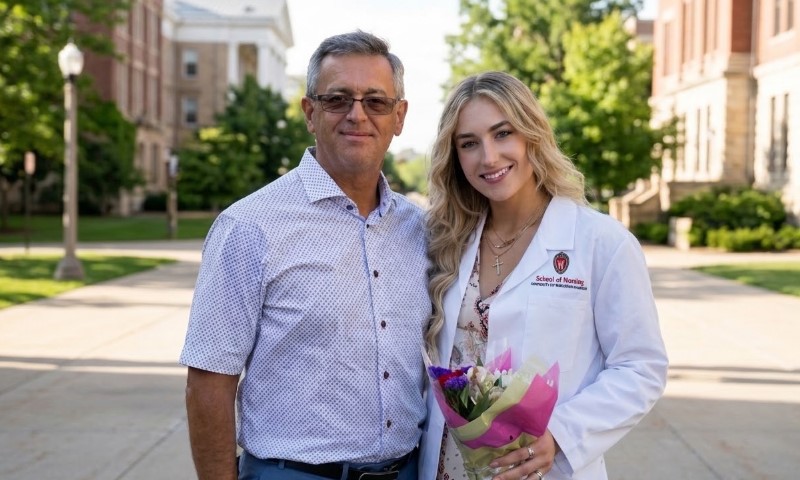
For roughly two decades, Dobrin Tchernev lived with chronic kidney disease. His condition became particularly serious in 2024 when it progressed to stage 5, the most advanced stage of the illness.
Stage 5 chronic kidney disease generally means kidney function has fallen below 15% of normal levels. At that point, the kidneys can no longer adequately filter waste and excess fluid, and patients may need dialysis or a kidney transplant.
Tchernev’s condition was associated with IgA nephropathy, also called Berger disease, a disorder in which deposits of an antibody called immunoglobulin A damage the kidneys.
Finding a living kidney donor became an urgent priority.
His daughter, Mira Tcherneva, refused to sit around hoping someone would eventually appear. A nursing student at the University of Wisconsin-Madison and a member of the Air National Guard, she took an active role in finding help.
Mira and her family promoted Dobrin’s situation through social media, advertisements, personal networks, and local television coverage. Their efforts brought attention to his medical condition and encouraged potential donors to consider getting tested.
Still, publicity couldn’t solve everything.
Kidney transplantation involves more than finding someone willing to donate. Blood type compatibility, immune-system testing, and the recipient’s medical condition all influence which kidneys can be transplanted safely.
Even a perfectly willing donor might not be a suitable match.
For Tchernev, finding that match proved difficult. Fortunately, someone watching the family’s story had an idea.
A Woman Who Decided to Help a Complete Stranger
Megan Bird had already thought about becoming a living kidney donor.
An earlier opportunity hadn’t worked out because she wasn’t a compatible match. Still, the idea of helping someone through organ donation stayed with her.
In February 2025, Bird learned about Tchernev’s situation through local news coverage. His story reminded her that people in her own community were facing serious medical challenges, and donating a kidney was something she could potentially do to help.
Unlike most people who see a moving news report and continue with their day, Bird decided to act.
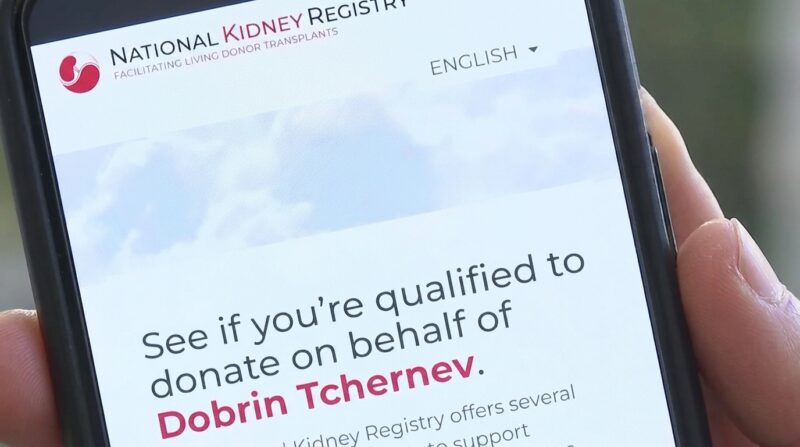
In July 2025, she donated a kidney through the National Kidney Registry.
One detail makes her decision especially interesting. Bird’s kidney didn’t go directly to Tchernev.
Instead, she participated in a program that allowed her donation to help him obtain a compatible kidney through another living donor.
How One Kidney Donation Helped Someone Else Get a Transplant
Ordinarily, people imagine kidney donation as a straightforward exchange. One person needs a kidney, another person offers one, and surgeons perform the transplant.
Actual transplant matching can be considerably more complicated.
Through the National Kidney Registry’s Voucher Program, a living donor can donate a kidney to a compatible recipient and designate another person to receive priority for a future living-donor transplant through the registry.
Such arrangements are particularly helpful when someone wants to donate to a specific person but isn’t medically compatible with them.
Here’s how the process works:
- A potential donor undergoes medical evaluations to determine eligibility.
- An approved donor provides a kidney to a compatible recipient through the registry.
- An intended recipient receives a voucher connected to that donation.
- When the voucher is activated, the registry searches for a suitable living donor kidney for that recipient.
Bird’s July 2025 donation provided the voucher that helped Tchernev enter the registry’s matching process.
Importantly, a voucher isn’t a physical kidney waiting in storage. It provides priority within a transplant-matching system, and an appropriate donor must still be identified. Medical eligibility also remains essential.
In Tchernev’s case, the arrangement worked.
A Phone Call in November 2025 Changed Everything
View this post on Instagram
After years of dealing with kidney disease, Tchernev finally received the news his family had been hoping to hear.
In November 2025, a call informed him that a kidney was available.
He reportedly had just 30 minutes to respond and accept the opportunity.
Imagine spending years searching for a suitable organ, only to have one of the biggest decisions of your life arrive with a half-hour deadline.
For Tchernev, there was little reason to hesitate.
He accepted the transplant opportunity and received a new kidney, with Bird’s earlier donation playing an essential role in making the procedure possible.
Her willingness to help someone she didn’t know had achieved exactly what she hoped.
An equally interesting part of the story developed afterward.
Tchernev and Bird eventually connected and began keeping in touch. A relationship that started through a medical donation program became a personal connection between two people who previously had no reason to know each other.
By October 2026, they were also sharing their experiences to encourage more people in Madison to consider organ donation.
Bird had initially wanted to help someone in her community. Now, she and Tchernev were encouraging others to consider doing the same.
Why Kidney Donations to Strangers Matter More Than You Might Think

Tchernev’s experience might sound like an unusual series of fortunate events, but it also points to an important issue in organ transplantation.
Thousands of Americans need kidney transplants, and the number of available organs cannot meet every patient’s needs.
Wisconsin offers a particularly clear picture of that shortage.
According to 2024 transplant data, more than 1,200 Wisconsin residents were waiting for kidney transplants. Kidneys accounted for approximately 80% of the organs patients were waiting to receive in the state.
Additional figures published by the American Kidney Fund show that Wisconsin performed 553 kidney transplants in 2024, including 169 using living donors and 384 using deceased donors. As of February 19, 2025, another 1,228 Wisconsin residents were on the kidney transplant waiting list.
Those figures help explain why living kidney donors are so important.
One Donor Can Help Several Patients
Kidney exchange programs can accomplish something that traditional one-to-one donation cannot always achieve.
Consider two patients, each with a willing donor who happens to be medically incompatible.
Under a paired donation arrangement, doctors may discover that the first patient’s donor matches the second patient, while the second patient’s donor matches the first.
Instead of two unsuccessful donation attempts, both patients could potentially receive kidneys.
Larger exchanges can connect several donor-recipient pairs, sometimes beginning with a person who volunteers to donate without having a particular recipient in mind.
A real Wisconsin example illustrates the potential.
Mike Crowley, CEO of the National Kidney Foundation of Wisconsin, donated a kidney in January 2025. His donation initiated a kidney exchange chain that ultimately helped four people receive transplants.
Not every donation produces a chain involving several recipients, and successful matching depends on medical compatibility and available participants. Still, such programs create opportunities that might otherwise never exist.
Donating a Kidney Is a Serious Medical Decision
Living donation offers considerable benefits to recipients, but it isn’t something prospective donors should approach casually.
Donors must undergo extensive medical evaluations, including blood tests, kidney function assessments, and reviews of their general health.
Donation also requires major surgery and a recovery period. Potential complications include bleeding, infection, blood clots, and other surgical risks.
Most carefully selected living kidney donors can lead healthy lives with one kidney, although individual circumstances and long-term health considerations matter.
Anyone interested in donation should speak with a qualified transplant team and receive an independent assessment before making a commitment.
For eligible donors, programs such as paired kidney exchange and voucher donation can make helping someone possible even when a direct match isn’t available.
Two Strangers, One Unexpected Connection
Megan Bird didn’t know Dobrin Tchernev when she first heard about his medical condition. She simply recognized an opportunity to help someone who needed it.
Her donation didn’t follow the familiar story of one person giving a kidney directly to another. Instead, it worked through a transplant system designed to connect people who might never otherwise find compatible donors.
For Tchernev, that system brought an end to years of searching and gave him the opportunity to spend more time with his family.
For Bird, an idea she had considered for years became something tangible.
Their continued connection has also given both a reason to talk publicly about living kidney donation and the possibilities available to people interested in helping.
Sometimes, making a difference in another person’s life doesn’t require knowing their name beforehand. In Bird’s case, it required a remarkable decision, a little medical coordination, and one kidney.