

History has a peculiar habit of making fiction look rather unimaginative. We remember kings, wars, revolutions, and discoveries, but occasionally, something happens that seems to belong in a particularly eccentric novel.
A medieval meeting ends in a sewage pit. An American wildlife department sends beavers parachuting into the wilderness. An entire city struggles to explain why its residents cannot stop dancing.
Some of the best weird history stories begin with perfectly ordinary problems and end somewhere nobody could reasonably have anticipated.
Yet what makes these strange true history stories worth examining is not simply their absurdity.
Historical records also require a little caution. Certain details have grown more spectacular with repeated retelling, while others are sufficiently peculiar without any embellishment.
Here are some bizarre historical events that actually happened, including a few details that popular versions tend to get wrong.
| Historical Event | Year | What Happened |
| Medieval Meeting Ends in a Latrine | 1184 | A floor collapsed during a gathering of nobles in Erfurt, reportedly killing around 60 people. |
| Strasbourg Dancing Epidemic | 1518 | Hundreds reportedly danced uncontrollably, with some collapsing through exhaustion. |
| Oliver Cromwell’s Posthumous Execution | 1661 | Cromwell’s corpse was exhumed, hanged, and beheaded three years after his death. |
| Ancient Egyptian Workers’ Strike | c. 1159 BCE | Tomb craftsmen at Deir el-Medina stopped working after their grain payments were delayed. |
| Sweden’s February 30 | 1712 | Sweden added an extra calendar day to correct an unsuccessful calendar reform. |
| Idaho’s Parachuting Beavers | 1948 | Wildlife officials parachuted 76 beavers into remote habitats, with 75 surviving the operation. |
| Mike the Headless Chicken | 1945-1947 | A chicken survived approximately 18 months after losing most of its head. |
| Battle of Castle Itter | 1945 | American and German soldiers fought together against Waffen-SS troops to protect French prisoners. |
| Project A119 | 1958 | American military researchers investigated detonating a nuclear weapon on the Moon. |
| Assassination of Franz Ferdinand | 1914 | A mistaken turn helped place the archduke’s automobile near assassin Gavrilo Princip. |
1. The Medieval Meeting That Ended in a Latrine (1184)
View this post on Instagram
Political meetings in medieval Europe could become heated affairs, particularly when powerful nobles gathered to settle territorial disputes. Few, however, ended quite as disastrously as a meeting held in Erfurt, Germany, on July 26, 1184.
A gathering of noblemen had assembled during the reign of Holy Roman Emperor Frederick Barbarossa. His son, the future Emperor Henry VI, was presiding over efforts to resolve a dispute involving influential regional figures.
Unfortunately, the building had a problem nobody seems to have appreciated until it was too late.
As participants crowded together, the wooden flooring gave way beneath their combined weight. Several nobles plunged through the structure and into a latrine cesspit below.
Contemporary accounts describe a horrifying scene in which men were trapped beneath debris or drowned in human waste. Around 60 people reportedly died, although the precise number is difficult to establish.
Among the victims were prominent members of the medieval aristocracy, turning a structural collapse into a serious political disaster.
Curiously, the underlying mechanism was rather ordinary.
Wooden beams could deteriorate, buildings were not always designed for large gatherings, and an unexpectedly heavy concentration of people could overwhelm an already weakened floor.
No amount of political influence could compensate for inadequate structural support.
Erfurt’s disaster is remembered partly because of its gruesome circumstances, but its broader significance lies in the sudden loss of important regional leaders during a delicate political dispute.
2. The Town That Couldn’t Stop Dancing (1518)
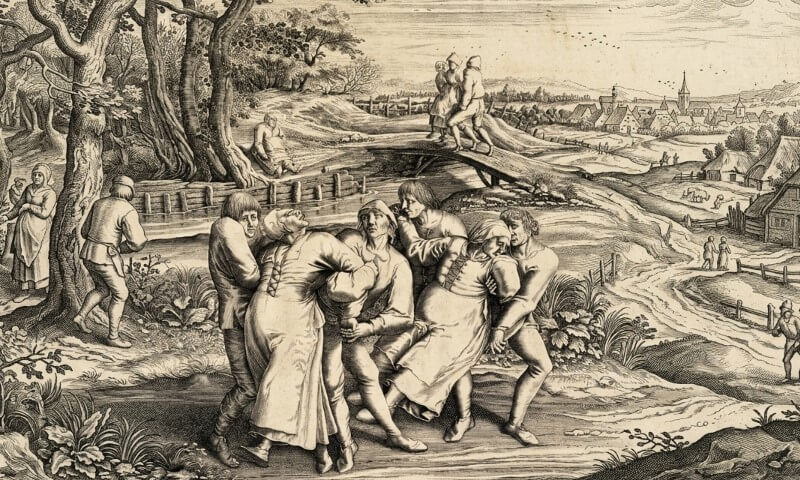
In July 1518, a woman reportedly stepped into a street in Strasbourg and began dancing.
Nothing particularly extraordinary about that, except that she apparently could not stop.
According to several historical chronicles, the woman, commonly identified as Frau Troffea, continued dancing for days. Other residents soon began exhibiting similar behavior, eventually creating one of Europe’s strangest recorded social disturbances.
Accounts describe approximately 34 participants within the first several days, with some estimates suggesting as many as 400 people were affected over the following month.
People reportedly danced until they collapsed through exhaustion.
Some later accounts even describe fatalities, although historians disagree about how many people died, or if the outbreak directly caused any deaths.
What Caused the Dancing Epidemic?
What could persuade so many people to dance involuntarily?
One explanation involves mass psychogenic illness, a phenomenon in which psychological distress can produce genuine physical symptoms across a group.
Strasbourg’s population had experienced considerable hardship, including food shortages, disease, and economic insecurity. Such conditions may have contributed to widespread psychological distress.
Historian John Waller examined these circumstances in his research on the dancing epidemic of 1518, published in 2008.
Religious beliefs also mattered. Many residents associated compulsive dancing with St. Vitus, whom they believed could inflict or relieve the condition.
Authorities initially attempted to manage the outbreak by providing places to dance and employing musicians, an intervention that seems rather counterintuitive today.
Strasbourg was not even the first European community to experience such an episode. A similar dancing outbreak spread through communities around Aachen in 1374.
No single explanation has achieved universal acceptance. Historical records establish that something extraordinary occurred, but reconstructing its precise medical and psychological causes after five centuries is considerably harder.
Among unbelievable history facts, Strasbourg’s dancing epidemic deserves particular attention precisely because the evidence supports the event more confidently than any explanation for it.
3. The King Who Executed a Man Three Years After His Death (1661)
Oliver Cromwell died in September 1658, having spent his final years as Lord Protector of England, Scotland, and Ireland.
Under normal circumstances, death might have settled his political difficulties. Unfortunately for Cromwell, the English monarchy had other ideas.
Cromwell had played a central role in the political upheaval surrounding the execution of King Charles I in 1649. When Charles II regained the throne in 1660, punishing those responsible became an important priority.
Cromwell was already dead, but that proved to be an inconvenience rather than an obstacle.
In January 1661, authorities exhumed his corpse and subjected it to a symbolic execution.
His body was hanged, and his head was subsequently removed and displayed at Westminster Hall.
Why Was Cromwell Executed After His Death?
Executing a corpse allowed the restored monarchy to demonstrate its rejection of the previous republican government. It also offered a visible warning about the consequences of challenging royal authority.
Cromwell’s head reportedly stayed on public display until around 1685, eventually entering private collections.
Its later history is unusually complicated, involving numerous owners and questions about authenticity.
According to Historic Royal Palaces’ account of Cromwell, a head identified as his was eventually buried beneath the chapel at Sidney Sussex College, Cambridge, in 1960.
More than three centuries separated Cromwell’s death and that final burial.
4. Ancient Egyptian Workers Went on Strike (12th Century BCE)

Royal tombs in ancient Egypt required skilled workers, careful planning, and substantial resources.
They also required something considerably less glamorous: regular payment.
Around 1159 BCE, during the reign of Ramesses III, craftsmen working at Deir el-Medina experienced delays in receiving their grain rations.
For these workers, grain was not simply a benefit supplied by their employer. It constituted an essential part of their compensation and supported their households.
When payments failed to arrive, the workers stopped working.
Rather than accepting the situation quietly, they organized protests, left their workplaces, and confronted officials responsible for distributing their supplies.
One of the most remarkable surviving records is the Turin Strike Papyrus, preserved by Museo Egizio in Italy.
Written by a scribe named Amennakht, the document describes workers protesting unpaid rations and demanding official intervention.
Their complaints concerned hunger, delayed compensation, and the authorities’ failure to meet established obligations.
Eventually, officials distributed overdue grain, although the wider problems contributing to the unrest were not permanently resolved.
An important distinction is often overlooked when discussing ancient Egyptian labor.
Skilled tomb workers at Deir el-Medina were organized craftsmen receiving compensation, not the enslaved laborers frequently associated with popular depictions of Egyptian construction.
Their protest is considered among the earliest documented labor strikes in history.
Of all the weird history stories involving ancient civilizations, this one may be the most familiar in spirit.
5. Sweden Once Had a February 30 (1712)
View this post on Instagram
Most people learn fairly early that February has 28 days, except during leap years, when it has 29.
Sweden briefly disagreed.
How Did Sweden End Up With February 30?
In 1700, Swedish authorities began an ambitious attempt to change their calendar. Rather than immediately adopting the Gregorian system, officials planned to make the transition gradually by omitting leap days over several decades.
A reasonable idea on paper, perhaps, but one that required consistent administration.
Sweden omitted the expected leap day in 1700, then failed to follow the plan in 1704 and 1708.
As a result, the country ended up using a calendar that matched neither the Julian nor the Gregorian system.
International coordination became unnecessarily complicated, particularly during the Great Northern War.
Eventually, Swedish authorities decided to abandon the gradual transition and restore the Julian calendar.
Doing so required correcting their accumulated one-day discrepancy.
Their solution was to add an extra day in 1712. Consequently, February that year had 30 days.
Sweden eventually adopted the Gregorian calendar in 1753, skipping 11 dates so that February 17 was immediately followed by March 1.
One calculation makes the episode particularly revealing.
Sweden’s original plan would have required ten omitted leap days over approximately 40 years. Instead, administrative interruptions produced a correction in 1712, followed by another major adjustment in 1753.
A reform intended to simplify timekeeping had created decades of additional confusion.
Historical calendars are a useful reminder that dates are administrative conventions as well as astronomical measurements.
Sometimes, even something as familiar as February depends on the government getting its paperwork right.
6. The Government That Dropped Beavers From Airplanes (1948)
Wildlife officials in Idaho faced an unusual problem during the late 1940s.
Beavers were causing difficulties near developing settlements, while remote wilderness areas offered suitable habitats for relocation.
Moving the animals, however, was another matter.
Mountainous terrain, limited roads, and lengthy journeys using pack animals made conventional transportation difficult.
Beavers were particularly troublesome passengers. They could become overheated, distressed, or aggressive during transportation, and horses were not especially enthusiastic about carrying them.
Wildlife officer Elmo Heter proposed an unconventional solution.
Why not deliver the animals by airplane?
How Did the Parachuting Beaver Experiment Work?
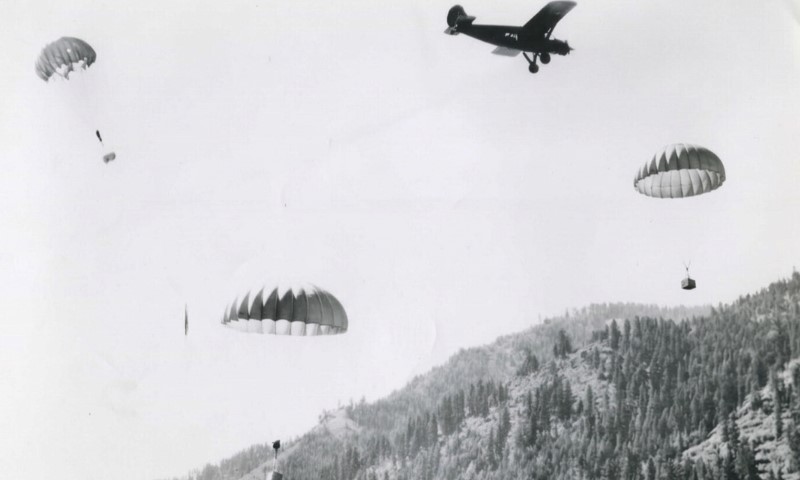
Using surplus parachutes associated with World War II and specially constructed wooden crates, Heter’s team developed a system for transporting beavers into isolated meadows.
Crate design was crucial. Containers needed to remain secure during flight and descent but allow the animals to escape after landing.
An older male beaver named Geronimo became the project’s principal test subject.
Geronimo endured repeated experimental drops while officials assessed parachute deployment, landing conditions, and the reliability of the containers.
Apparently, he eventually became accustomed to the procedure.
During August 1948, officials parachuted 76 beavers into remote wilderness habitats.
Seventy-five survived the operation.
One animal died after escaping its container during descent and falling before reaching the ground.
Wildlife officials subsequently reported that relocated animals were constructing dams and establishing themselves in their new surroundings.
Although the method sounds unnecessarily theatrical, it addressed a genuine logistical problem.
Compared with difficult overland transportation, aircraft could deliver animals directly into suitable habitats without prolonged handling.
Survival during the drop, however, should not be confused with proof that every relocated animal survived long-term.
7. The Chicken That Lived Without Most of Its Head (1945-1947)
In 1945, a Colorado farmer named Lloyd Olsen attempted to slaughter a chicken on his property near Fruita.
Something extraordinary happened.
Although the axe removed most of the bird’s head, the chicken survived.
Instead of dying immediately, the animal continued moving and displaying basic behaviors.
Olsen eventually named him Mike, and the remarkable bird became famous across the United States.
How Did Mike Survive Without Most of His Head?
Understanding Mike’s survival requires looking at avian anatomy.
A chicken’s brainstem controls essential automatic functions, including aspects of breathing and cardiovascular regulation.
Mike’s injury left sufficient brainstem tissue intact to sustain those functions. A blood clot also helped prevent fatal blood loss.
In other words, Mike had lost most of his head without losing all the nervous tissue necessary for survival.
Still, surviving the original injury was only part of the challenge.
His owners provided food and water using an eyedropper, delivering nourishment directly into his exposed throat. Maintaining his airway also required careful attention.
Mike eventually became a traveling attraction, drawing audiences fascinated by an animal that appeared to contradict basic biological expectations.
Scientists examined the circumstances of his survival, while newspapers and magazines documented his extraordinary condition.
For approximately 18 months, he continued living despite his injuries.
In March 1947, Mike died after choking while traveling with his owners, reportedly because the equipment normally used to clear his airway was unavailable.
His story is among the more extraordinary biological cases associated with twentieth-century American history.
Yet the explanation does not require anything supernatural.
Survival depended on an exceptionally improbable injury, preserved nervous tissue, and sustained human assistance.
Mike was extraordinary, but he was not biologically inexplicable.
8. The Battle Where Americans and Germans Fought Together (1945)
By May 1945, Nazi Germany was approaching military collapse.
German forces were surrendering, political authority was disintegrating, and soldiers faced increasingly difficult decisions about whom they should obey.
Against this background, one of World War II’s strangest engagements unfolded at Castle Itter in Austria.
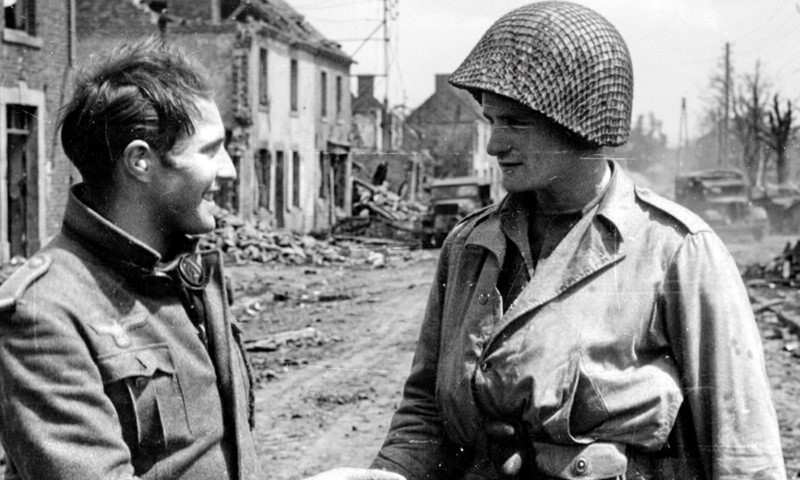
On May 5, American soldiers fought alongside German Wehrmacht personnel and other defenders against attacking Waffen-SS troops.
Such an alliance would have seemed almost impossible earlier in the war.
Castle Itter housed prominent French prisoners, including former government officials, military figures, and celebrated personalities.
Among them were former French prime ministers Édouard Daladier and Paul Reynaud, tennis champion Jean Borotra, and Marie-Agnès Cailliau, the sister of Charles de Gaulle.
As Germany’s military position collapsed, the prisoners faced an uncertain future.
German Major Josef Gangl, who had been cooperating with anti-Nazi resistance, helped organize their defense and contacted American forces.
American Captain John C. Lee Jr. subsequently joined the effort.
A small group of Americans, German soldiers, and other defenders prepared to resist an attack by Waffen-SS troops.
During the fighting, a Sherman tank positioned near the castle was destroyed, leaving the defenders with fewer resources.
Gangl was killed while helping protect the prisoners.
Eventually, American reinforcements arrived and the surviving defenders and prisoners were rescued.
Castle Itter is frequently described as one of the rare occasions when American and German soldiers fought on the same side during World War II.
Yet describing it simply as Americans and Germans fighting together risks obscuring an important distinction.
9. The American Military Considered Nuking the Moon (1950s)
In October 1957, the Soviet Union launched Sputnik 1, the world’s first artificial satellite.
For American officials, the achievement represented more than a scientific milestone.
It raised unsettling questions about Soviet technological capabilities and the military implications of increasingly powerful rockets.
During the ensuing Space Race, American researchers investigated numerous proposals intended to demonstrate technological superiority.
One involved detonating a nuclear weapon on the Moon.
Project A119, initiated in 1958, examined the scientific and practical implications of such an explosion.
Physicist Leonard Reiffel led research associated with the proposal, while other participating scientists included a young Carl Sagan, who would later become internationally recognized for his work in astronomy and science communication.
Why Did the U.S. Consider Nuking the Moon?
An important objective was determining how visible a nuclear explosion might be to observers on Earth.
A carefully positioned detonation could potentially demonstrate American capabilities to the Soviet Union and the wider world.
Researchers also considered scientific questions involving lunar conditions and the effects of nuclear explosions in an environment considerably different than Earth’s.
Yet the proposal presented obvious difficulties.
Radioactive contamination, technical limitations, and the potential loss of scientific opportunities complicated the idea.
Project A119 never resulted in an actual lunar mission.
Its existence became more widely known decades later, supported by surviving research documentation and statements by participating scientists.
A 1958 report, A Study of Lunar Research Flights, provides documentary evidence of the research program.
What makes this one of the more disturbing bizarre historical events is that the proposal was examined by serious scientists working within an official military research program.
Cold War competition had created an environment in which detonating a nuclear weapon on another celestial body could be considered a potentially useful demonstration of national capability.
Fortunately, the Moon was spared that particular form of international communication.
10. The Wrong Turn That Helped Change World History (1914)
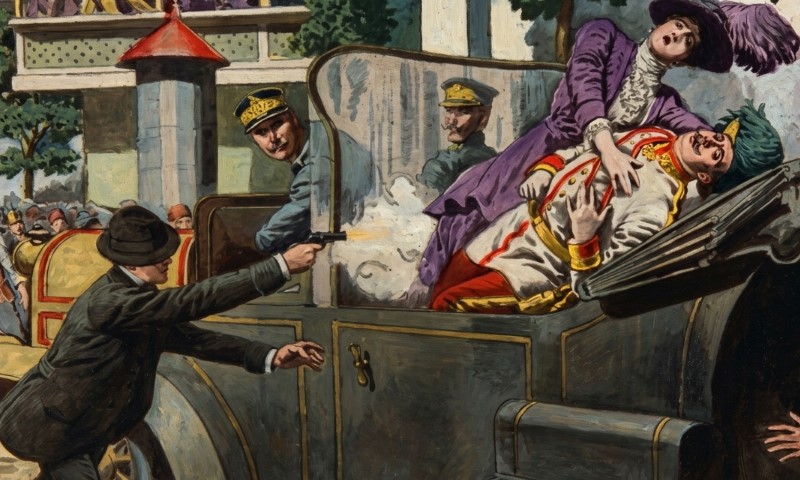
On June 28, 1914, Archduke Franz Ferdinand and his wife Sophie visited Sarajevo, then part of Austria-Hungary.
Security concerns were considerable, but the royal visit proceeded.
During the morning, an assassin threw a bomb toward the archduke’s automobile.
Franz Ferdinand survived, although the explosion injured members of his entourage.
Under ordinary circumstances, surviving an assassination attempt might have persuaded the couple to leave immediately.
Instead, the archduke decided to visit those injured in the bombing.
Unfortunately, communication about the revised route was inadequate.
As the motorcade traveled through Sarajevo, driver Leopold Lojka made a mistaken turn onto Franz Joseph Street.
When the error was recognized, the vehicle stopped near a young assassin named Gavrilo Princip.
Princip had participated in the earlier assassination conspiracy and was still armed.
With the archduke’s automobile unexpectedly close, he fired two shots, fatally wounding Franz Ferdinand and Sophie.
Their deaths triggered the July Crisis, during which diplomatic confrontation, military preparations, and existing European alliances contributed to the outbreak of World War I.
Did Gavrilo Princip Really Stop for a Sandwich?
A popular version of the story adds another curious detail.
According to this account, Princip had stopped to buy a sandwich and happened to encounter the archduke’s automobile outside a delicatessen.
Unfortunately, that detail lacks support in contemporary testimony.
Historical investigations have found no convincing evidence that Princip was eating a sandwich when the assassination occurred.
Even the idea that he happened to be somewhere entirely unexpected is misleading. Princip was positioned near a street associated with the motorcade’s originally planned route.
No sandwich is necessary to explain what happened.
A surviving target, a changed itinerary, inadequate communication, and a vehicle stopping near an armed conspirator already provide a remarkable sequence of events.
One distinction matters when considering the wider consequences.
A wrong turn helped place the archduke within reach of his assassin, but a single driving mistake did not independently cause World War I.
Political tensions, military alliances, competing national ambitions, and decisions made by European governments were essential to the escalation that followed.
History frequently compresses complicated events into memorable anecdotes.
Closing Thoughts
Looking closely at these weird history stories reveals an interesting pattern.
People seldom recognize the historical significance of their actions while they are making them.
Not every spectacular detail survives scrutiny. Death tolls are sometimes uncertain, explanations change as research advances, and an especially convenient anecdote may turn out to have appeared long after the actual event.
Yet careful examination seldom makes the past less interesting.
Perhaps the most surprising quality of these strange true history stories is how recognizable the people involved become once their circumstances are considered.