
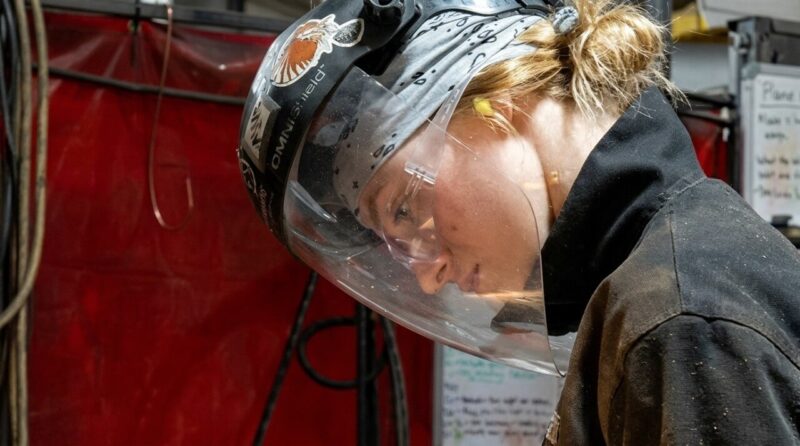
Most 21-year-olds aren’t spending 80 hours a week practicing how to weld metal. Mikala Sposito, a young welder out of Dexter, Michigan, did exactly that, and the effort earned her a place in history.
In September 2026, Sposito won a bronze medal at the WorldSkills Competition in Shanghai, China, becoming the first woman to win a medal in welding at the international event. She was also the first woman ever selected to represent the United States in that category.
WorldSkills is often called the Olympics of the skilled trades.
Nearly 1,400 competitors representing 73 countries and regions participated in the 2026 event, competing across 64 technical skills.
For Sposito, reaching that level meant years of training, help provided by local instructors, and a willingness to spend an extraordinary amount of time in a welding lab.
A Childhood Welding Demonstration Started Everything
Sposito’s interest in welding began when she was just 10 years old.
During a Maker Faire event at the Henry Ford Museum, she encountered a virtual welding demonstration operated through an American Welding Society mobile trailer.
Something about the experience caught her attention. While plenty of children might have enjoyed the demonstration and moved along, Sposito decided welding was something she wanted to pursue seriously.
Years later, she began developing her skills through Dexter High School and the South & West Washtenaw Consortium, which provides career and technical education opportunities to students in the area.
Her training eventually continued at Washtenaw Community College in Ann Arbor, where she worked with welding instructor Alex Pazkowski.
Pazkowski knew a thing or two about international competition. He represented the United States at WorldSkills in 2013 and earned a silver medal.
Having a former medalist as an instructor gave Sposito access to someone familiar with the demanding technical requirements and preparation involved.
Still, knowing what to practice and actually putting in the hours are two different matters.
Sposito trained between 60 and 80 hours per week over roughly two years while preparing for WorldSkills.
Even holidays weren’t necessarily days off. She practiced welding on Christmas Day, Christmas Eve, New Year’s Eve, and her birthday.
During high school, her schedule involved regular classes, track practice, and evening welding sessions at Washtenaw Community College.
By the time she qualified for international competition, welding had occupied a considerable portion of her teenage years.
Competing Against the World’s Best in Shanghai
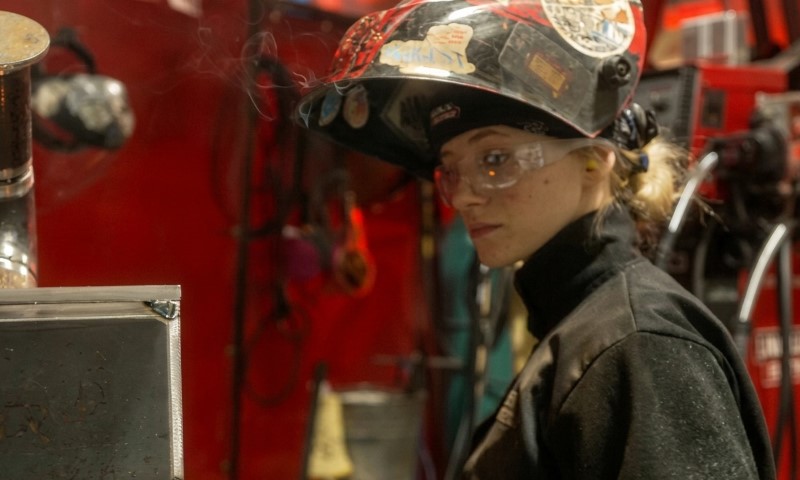
Earning a spot on the American team was its own competition.
Sposito secured her position by winning the USA Weld Trials at the Robotics Technology Park in Huntsville, Alabama.
Across three qualifying events, participants were evaluated on technical accuracy, workmanship, safety, and their ability to complete complicated welding assignments within strict time limits.
Sposito finished first overall, earning the opportunity to represent the United States in Shanghai.
Competition at WorldSkills took place September 22 through 27, 2026.
Welders had to prepare, cut, and join steel, aluminum, and stainless steel plates and pipes. Tasks required different welding methods and positions, with judges evaluating the quality and accuracy of the finished work.
A good weld involves considerably more than getting two pieces of metal to stick together.
Competitors must control heat, maintain proper technique, follow technical specifications, and produce reliable joints. Small mistakes can affect the finished product and the score.
At that level, steady hands, concentration, fine motor skills, and technical judgment matter enormously.
Sposito has also pointed out that welding isn’t simply a contest of physical strength. Precision, coordination, and problem-solving often matter much more.
Her bronze medal made her the first female welding medalist in WorldSkills history.
Competition results show just how close the top finishers were. Sposito scored 723 points, tying Japan’s Ooki Fukui for fourth overall among 37 competitors. Both received bronze medals.
China’s Qiansen Zhao took gold with 735 points, while the two silver medalists finished with 728. Just 12 points separated Sposito and the gold medalist, which says quite a bit about the level of precision involved.
That achievement carries a little more weight when you look at the American welding workforce.
In 2024, women accounted for just 5.4% of the country’s 552,843 welding, soldering, and brazing workers. Men made up the other 94.6%. Sposito entered an international competition in a profession where women are still heavily outnumbered, then earned a spot on the podium.
Already the first woman selected to represent the United States in the competition, she returned to Michigan with another historic achievement and a medal to show for those long training sessions.
A Homecoming Worth Celebrating
View this post on Instagram
On October 29, 2026, Washtenaw Community College hosted a celebration recognizing Sposito’s international achievement.
Family members, educators, industry representatives, and supporters gathered to congratulate the Dexter High School graduate.
Before the ceremony, Sposito gave welding demonstrations inside the college’s lab.
Apparently, winning an international medal wasn’t enough to get her away from the welding equipment for an entire afternoon.
One particularly fitting detail involved the American Welding Society’s mobile welding trailer.
The same trailer that introduced Sposito to welding at age 10 was present at her homecoming celebration.
Her instructor, Alex Pazkowski, had also helped design that trailer, adding another connection between her childhood introduction to welding and her later success.
Sposito thanked Dexter High School, the South & West Washtenaw Consortium, and the teachers and coaches who helped her develop her abilities.
Washtenaw Community College has considerable experience preparing international welding competitors.
Along with Pazkowski, instructors Glenn Kay and Brad Clink previously represented the United States at WorldSkills in 1997 and 2011, respectively.
For a community college welding program, having several instructors with international competition experience provides students with valuable technical knowledge and practical coaching.
Sposito’s medal offered another example of what those local training opportunities can produce.
What’s Next for Michigan’s History-Making Welder?
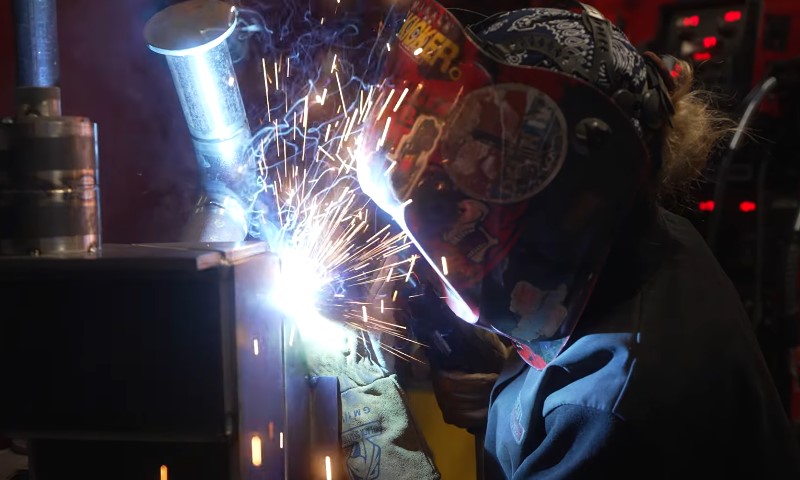
Winning bronze in Shanghai hasn’t ended Sposito’s plans for welding.
She intends to continue her education, pursue a bachelor’s degree, and develop her knowledge of welding engineering. Wayne State University has been among the schools she has expressed interest in attending.
She has also discussed the possibility of becoming an instructor or mentor herself.
Given how much guidance she received through her own training, helping younger welders would be a fitting next step.
Her accomplishment also gives young women considering skilled trades a concrete example of what is possible.
Welding has traditionally been a male-dominated profession, and Sposito entered an international competition where no woman had previously earned a medal in the category.
She didn’t change that record through a special exemption or a different set of technical requirements. She qualified through the same demanding selection process and earned her medal against elite international competitors.
For Dexter and the surrounding communities, her success also draws attention to the value of local technical education.
Access to instructors, equipment, training programs, and competitions helped turn an early interest into a professional ambition.
Of course, Sposito supplied the rather substantial amount of practice.
Years earlier, she was a 10-year-old trying a welding simulator at a museum event. By September 2026, she was standing among the world’s best young welders with a bronze medal.
Not every child who tries a welding simulator will eventually earn an international medal. But in Dexter, Michigan, there’s now proof that it can happen.