
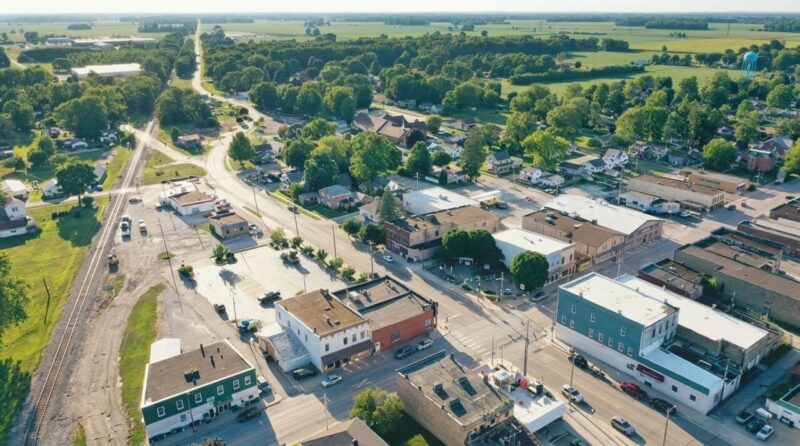
By April 2026, much of Bourbon, Indiana, looked like a town that had managed to put a terrible night behind it. Damaged roofs had been repaired, buildings restored, and neighborhoods that once required extensive cleanup were beginning to look familiar again.
Only a year earlier, on April 2, 2025, an EF-1 tornado had torn through the community of approximately 1,600 residents, damaging dozens of properties and forcing families out of their homes.
Within 12 months, a majority of the town had been rebuilt, an outcome that arrived sooner than many anticipated.
Recovery hadn’t depended on a single enormous donation or an unusually generous benefactor. Neighbors, volunteers, local institutions, and businesses across Indiana had contributed what they could.
One fundraising effort even managed to turn the town’s name into a rather appropriate business proposition. Bourbon was going to help Bourbon, one bottle at a time.
The Tornado That Changed Bourbon
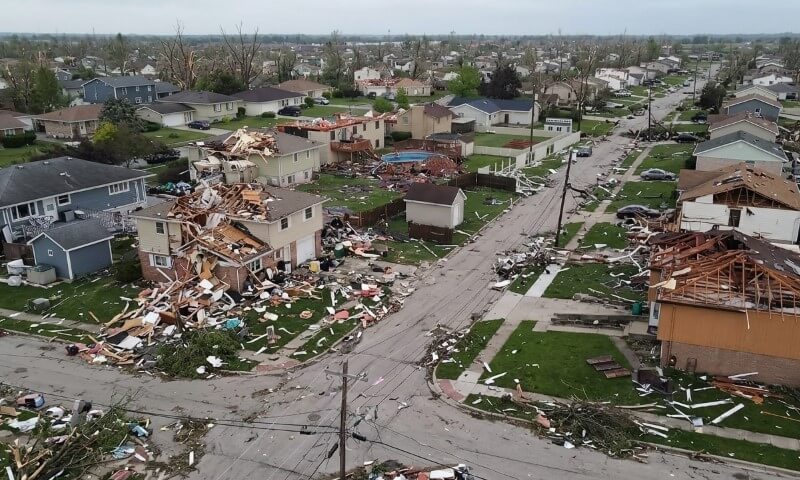
April 2, 2025, brought a powerful line of severe thunderstorms across northern Indiana. For Bourbon, the consequences became apparent shortly before 8 p.m.
According to the National Weather Service’s official damage survey, an EF-1 tornado touched down southeast of Rutland at 7:52 p.m. and traveled northeast before dissipating north of Etna Green at approximately 8:10 p.m.
Estimated peak winds reached 105 mph, placing the tornado near the upper end of the EF-1 classification, which covers winds of 86 to 110 mph.
Its recorded path extended approximately 17.9 miles, with a maximum width of 175 yards.
Those figures explain the storm’s intensity, although they say little about what residents encountered afterward.
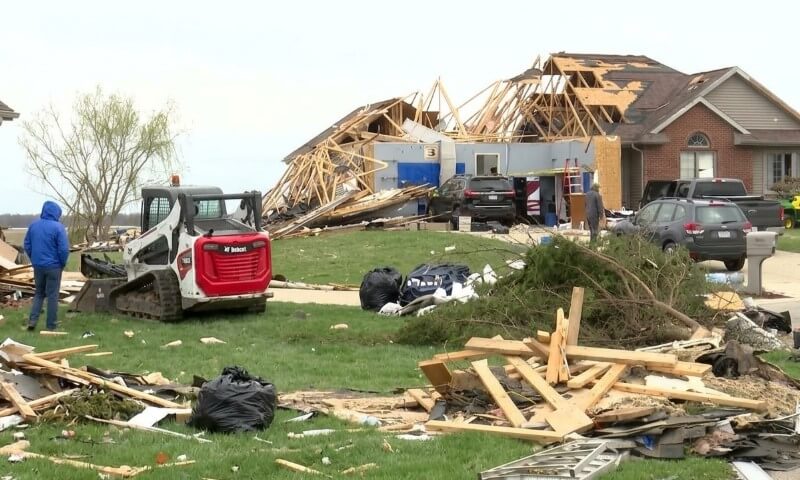
Significant damage occurred around Crocus Court and Rose Lane, where several homes lost substantial portions of their roofs. Trees were snapped or uprooted, garage doors were damaged, and debris scattered across residential properties.
Nearby U.S. 30 also experienced disruption after several semitrailers overturned.
Initial reports suggested that 30 homes had been damaged and 11 families displaced. By April 3, however, Marshall County Emergency Management officials were reporting damage to at least 50 homes and other buildings.
Not every property required complete reconstruction, but the broader figure revealed how many separate repair projects a town of approximately 1,600 residents suddenly faced.
NOAA’s storm records put the estimated property damage in Marshall County at $600,000.
Even that figure offers only a partial accounting of the consequences, since the recorded estimate does not capture every expense associated with displacement, temporary housing, or long-term rebuilding.
For affected homeowners, the practical question was less about the countywide total and more about how quickly their own property could become habitable again.
Such differences matter. Initial household figures and later building assessments measure different parts of the disaster, rather than offering competing totals.
Official storm records reported no fatalities or injuries directly associated with the Bourbon tornado. Considering the extent of the property damage, that was an important distinction.
Residents nevertheless faced immediate practical problems. Damaged roofs needed protection, fallen trees blocked access, and families whose houses were no longer habitable needed somewhere to sleep.
For a community Bourbon’s size, even a few dozen damaged properties represented a substantial recovery effort.
Neighbors Became the First Line of Recovery
Emergency assistance began almost immediately.
First responders searched affected properties, while local officials established emergency coordination operations. Bourbon’s volunteer fire department and other community organizations became important parts of the response.
Triton School Corporation also stepped forward, opening the high school as an emergency shelter and canceling classes on April 3 to accommodate cleanup and recovery operations.
One particularly telling example involved high school baseball players.
Triton’s scheduled home opener against Tippecanoe Valley was interrupted by the storm. Instead of playing baseball, students and coaches helped clear damaged neighborhoods.
Players representing both schools participated in cleanup activities, turning an ordinary school sports day into something considerably more useful.
Such efforts addressed an immediate problem: debris could obstruct streets, yards, and access to damaged buildings, delaying inspections and repairs.
Clearing those obstacles was only the beginning.
Replacing roofing, repairing structural damage, and restoring utilities required specialized labor, materials, money, and time. Volunteer cleanup could accelerate the initial response, but it could not eliminate the expense of rebuilding.
Financial assistance also carried uncertainty, especially for households facing immediate expenses while insurance claims or other support were still unresolved.
A donated afternoon could clear someone’s driveway. Paying for a replacement roof was another matter.
Bourbon needed both kinds of help.
Bourbon 4 Bourbon – An Unusual Fundraiser With a Serious Purpose
View this post on Instagram
Nate Spangle grew up in Bourbon but was living in Indianapolis when the tornado struck.
At 38, the founder of Get Indiana and host of the Get IN podcast had established a career centered on connecting people and promoting Indiana communities.
News of the destruction in his hometown prompted him to organize a fundraiser with an unusually convenient name.
Bourbon 4 Bourbon partnered with Indianapolis-based Rare Saint Whiskey to offer 200 bottles of limited-release single-barrel bourbon, with proceeds intended to help storm victims.
Organizers established a goal of $20,000 by April 30, 2025.
By April 14, the campaign had collected more than $4,000 through contributions by dozens of supporters.
Rather than relying exclusively on conventional donations, organizers offered several contribution levels tied to the whiskey release.
A $100 contribution qualified a donor for an exclusive bottle. Higher levels included additional bottles, personal delivery within Indiana, and other rewards. A $2,500 contribution offered a private dinner at Indianapolis’s St. Elmo Steak House and a case of bourbon.
Alcohol-related rewards were restricted to Indiana residents aged 21 and older.
Campaign organizers coordinated with Bourbon’s volunteer fire department and Marshall County United Way to direct assistance toward affected households.
Planned expenditures included hotel vouchers, grocery gift cards, building materials, and other immediate necessities.
Such assistance addressed a familiar problem after major storms. Housing expenses and everyday bills do not stop simply because a family’s property has been damaged.
Hotel vouchers could provide temporary shelter, while grocery assistance helped households preserve money for repairs and other urgent obligations.
Why the Fundraiser’s Numbers Matter
A simple calculation provides perspective on the campaign’s ambitions.
With a target of $20,000 and 200 limited-release bottles available, organizers were effectively seeking an average of $100 per bottle in fundraising revenue, assuming all 200 bottles were allocated at the basic contribution level.
Actual contributions could vary because the campaign included several donation tiers.
By April 14, the reported total exceeded $4,000, equivalent to more than 20% of the original target.
That figure demonstrated meaningful early participation, but it did not establish the campaign’s eventual total or how much money was ultimately distributed.
Nor can Bourbon’s broader rebuilding success be attributed to the whiskey fundraiser alone.
Its significance lies partly in something harder to measure. People who had moved away could participate in their hometown’s recovery without returning to carry debris or repair buildings.
For Spangle, living roughly 150 miles away did not prevent him from making a practical contribution.
A town of 1,600 residents suddenly had a fundraising network reaching across Indiana.
One Year Later – Most of Bourbon Rebuilt
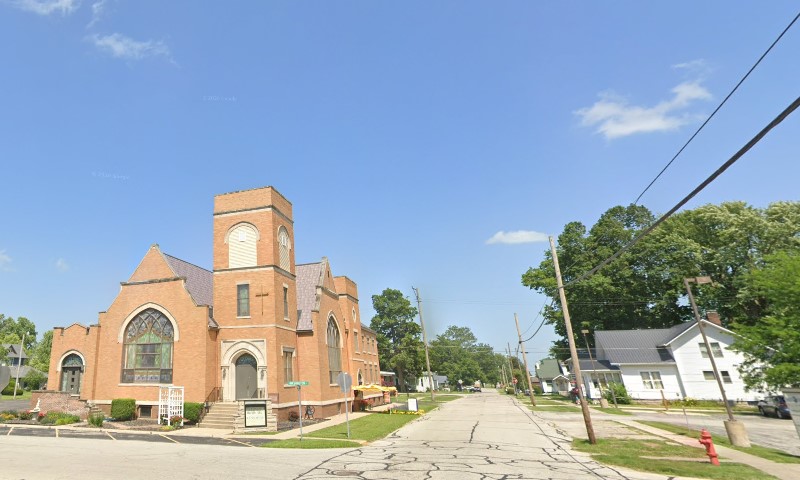
By April 2, 2026, Bourbon had achieved substantial physical recovery.
A majority of the town had been rebuilt, with assistance provided by volunteers, neighboring communities, and local organizations.
Considering the damage sustained during those 18 minutes in April 2025, progress was considerable.
Yet the phrase most of the town deserves careful attention.
Public reporting did not establish that every damaged house had been fully repaired, that all displaced households had returned, or that every resident had recovered financially.
A community can restore much of its physical infrastructure while individual families continue dealing with expenses, property losses, or uncertainty about future storms.
Recovery also involves more than construction.
In March 2026, shortly before the tornado’s first anniversary, severe weather once again affected Marshall County. Bourbon residents recalled the previous year’s destruction as strong winds brought renewed concerns.
For people who had experienced extensive damage, another storm warning was no longer an abstract possibility.
That reaction points to an important distinction between rebuilding property and rebuilding confidence.
A repaired roof offers protection against ordinary weather. It cannot guarantee that another tornado will miss the same neighborhood.
Bourbon’s experience also demonstrates why recovery figures require context. An EF-1 classification describes estimated tornado intensity, not the total economic consequences for an affected community.
Even a tornado below the strongest categories can generate expensive structural repairs, displacement, and prolonged disruption.
In Bourbon, the concentrated damage to residential streets made the consequences especially visible.
One year later, considerable evidence of that damage had disappeared. Residents, however, had good reason to remember precisely where it occurred.
A Town Put Back Together
Bourbon’s recovery was accomplished through contributions that were often ordinary in isolation.
Students cleared debris. Neighbors assisted damaged households. Emergency workers coordinated immediate needs. Local organizations arranged practical support, while businesses and former residents helped raise money for families facing difficult expenses.
None of those efforts could have repaired the entire community independently.
Together, they helped make substantial rebuilding possible within a year.
An important distinction nevertheless accompanies the encouraging outcome. Restored buildings provide visible evidence of progress, but they cannot account for every expense, disruption, or lingering concern.
By April 2026, Bourbon had repaired much of what the tornado damaged.
A visitor might have had difficulty identifying some of the properties affected just 12 months earlier. Residents who lived through those 18 minutes probably needed no reminder.
Sometimes a town’s most impressive achievement is getting back to the point where nothing looks particularly remarkable.
For Bourbon, that ordinary appearance took an extraordinary amount of work.