
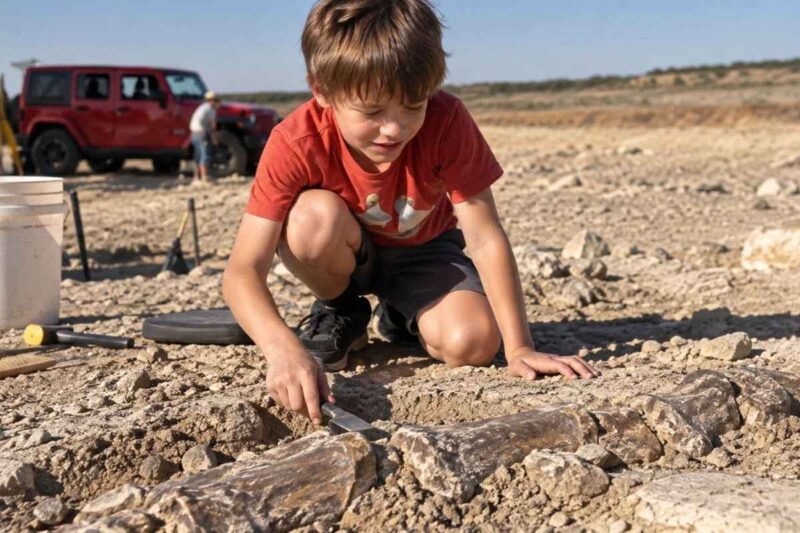
Corbin Bullard was supposed to be looking for fossils during a 4-H geology club outing in September 2025. A few shark teeth would have made for a respectable day. Instead, the 11-year-old spotted several unusually large bones sticking out of the ground at a quarry in Jewell County, Kansas.
Corbin, a sixth-grader living in Clearwater, had wandered a short distance away when he noticed six or seven vertebrae exposed in the rock.
“I didn’t know what it was, but I knew that it was something big,” he later told FOX Local. Big turned out to be a fairly cautious description.
Buried beneath the Kansas quarry was a Tylosaurus, a massive marine reptile that prowled prehistoric seas roughly 85 million years ago.
Getting it out would eventually require three additional trips, several volunteers, and a fair amount of patience. Corbin had gone looking for fossils and accidentally given his geology club a much larger project than anyone had scheduled.
A Kansas Quarry That Used to Be Underwater
Geology clubs visit quarries in the area because exposed rock layers offer opportunities to collect fossils. Commercial excavation can uncover material that has spent millions of years underground, although recognizing something important among all that rock still takes a good eye.
Around 85 million years ago, much of present-day Kansas lay beneath the Western Interior Seaway, an enormous inland sea that divided North America.
Marine reptiles, sharks, and large fish occupied waters that now correspond to farms, county roads, and communities where the nearest ocean is a very long drive away.
Some animals sank to the seafloor after dying and became buried in sediment. Over millions of years, those deposits hardened into rock, preserving bones inside formations such as the Smoky Hill Chalk.
Kansas has produced major marine fossil discoveries for generations. Paleontologist Benjamin Mudge recovered a plesiosaur in Jewell County in 1874.
Finding prehistoric sea life in Kansas isn’t particularly unusual, at least to someone familiar with its geology.
Finding a substantial marine predator while accompanying a group of children on a field trip is another matter.
What Corbin Found Was No Ordinary Fossil
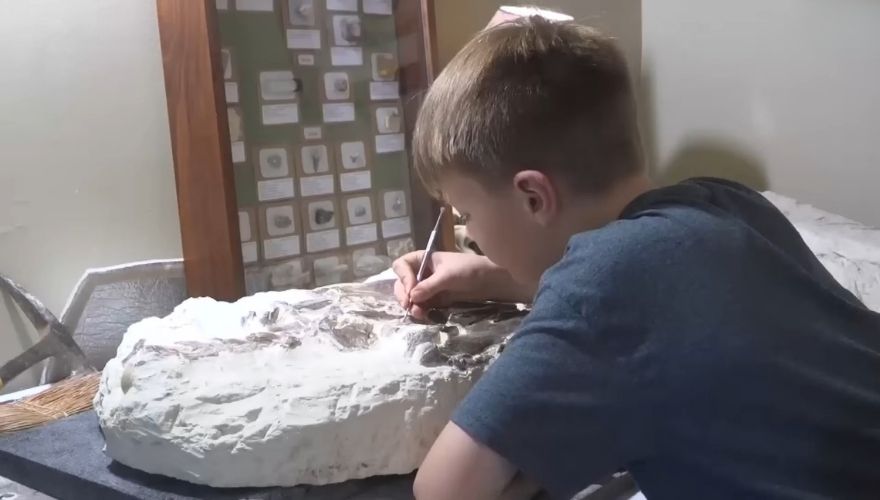
Harry, as Corbin eventually named his discovery, wasn’t a dinosaur, although the distinction probably mattered less to the boy initially staring at those enormous vertebrae.
Tylosaurus belonged to the mosasaur family, a group of large marine reptiles that lived during the Late Cretaceous Period.
With powerful jaws, sharp teeth, and tails adapted for swimming, these animals occupied a prominent position in the prehistoric marine food chain.
Some Tylosaurus specimens reached approximately 45 feet long, making them unpleasant company for almost anything sharing the water.
Kansas designated Tylosaurus its official state marine fossil in 2014, so Corbin had managed to uncover a rather substantial piece of state history.
His recovered specimen measured more than 15 feet, although that figure doesn’t tell the entire story.
Much of the animal’s tail was missing, meaning nobody can establish its full original length simply by measuring the recovered bones.
Its exact size when alive remains uncertain.
Geological evidence places the fossil’s age at approximately 82 million to 87 million years, during a period when Kansas offered considerably better conditions for marine predators than it does today.
Whatever Harry’s original measurements, the exposed vertebrae were enough to make Corbin realize he had found something worth investigating.
Finding the Bones Was the Easy Part
Discovering a fossil is exciting. Removing one without breaking it is a different sort of activity, particularly when the animal was several times longer than the person who found it.
Corbin returned to the Jewell County quarry three more times alongside fellow Sedgwick County 4-H Geology Club members and adult volunteers.
Excavation required careful work around bones that had been buried for millions of years.
Fossil material can fracture during removal, and separating it safely requires more patience than simply digging until something comes loose. Harry also had an awkward surprise waiting underground.
His skull had bent backward toward his spine before fossilization, leaving the bones in a position that initially made little sense to the people uncovering them. Shannon Crouch, whose daughter Zoe helped with the excavation, described the difficulty of figuring out how the different parts fit together.
Once the arrangement became clearer, the group could better identify what it was handling. Eventually, volunteers recovered the fossil in eight sections, using natural breaks in the material to separate portions without unnecessarily damaging them.
Harry’s skull alone measured nearly three feet and needed a wooden box for protection while work continued on the other pieces.
Some sections still required additional preparation after excavation.
By then, Corbin’s discovery had become an exercise in transportation, preservation, and finding enough people willing to spend another day working in a quarry.
Nobody was going to carry Harry home in a backpack.
It Took a Geology Club to Raise a Sea Monster
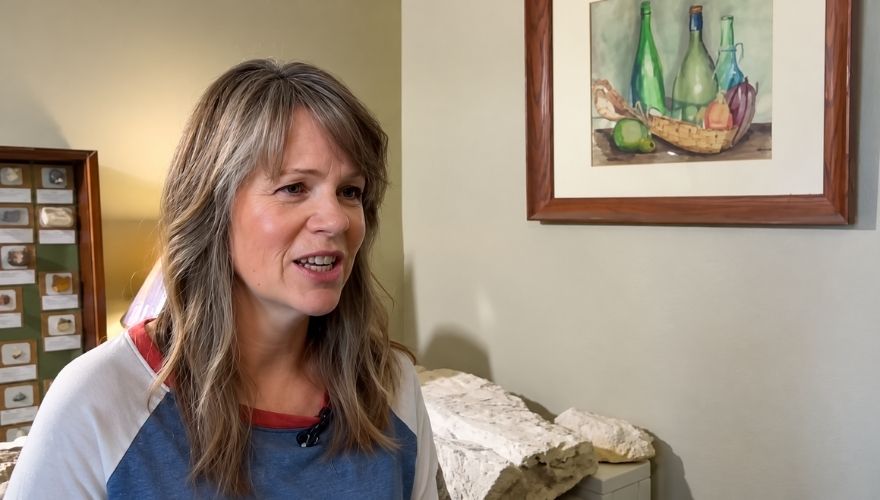
Corbin spotted the first bones, but getting Harry out of the ground required a small collection of people with different responsibilities.
Crista Burnett, a leader of the Sedgwick County 4-H Geology Club, helped organize the activities that brought the children to the quarry in the first place.
Club members regularly study rocks and fossils, take field trips, and prepare educational projects.
Occasionally, as Burnett and her group discovered, a routine outing turns into something that requires several return visits and considerably more equipment. Private landowners also had an important part in the story.
Because the quarry was on private property, the club needed permission to collect fossils and carry out the excavation. Access to suitable land can determine which discoveries amateur fossil hunters are able to investigate.
Wendy Bullard, Corbin’s mother, credited the club’s leaders, volunteers, and property owners for helping make the excavation possible.
Other young members also worked on the fossil, including Zoe Crouch, who was nine when the bones were discovered.
For Zoe and her fellow club members, the project meant participating in an actual fossil recovery rather than simply examining specimens someone else had already prepared. Corbin also gained experience researching his discovery and presenting information to other people, skills encouraged through 4-H activities.
Finding a large prehistoric reptile certainly gives a young geology enthusiast something interesting to discuss.
A Prehistoric Predator Named Harry Goes to the Fair
At some point during the excavation, Corbin decided his prehistoric marine predator needed a name.
He chose Harry.
For an animal once equipped with a mouthful of sharp teeth and enough size to intimidate other ocean creatures, Harry sounds remarkably approachable.
Fortunately, the original animal was no longer in a position to object.
Corbin had more practical matters to handle anyway. Preparing Harry’s nearly three-foot skull for public exhibition required careful preservation and an educational display explaining what visitors were looking at.
By July 2026, Harry had made it to the Sedgwick County Fair.
Corbin entered the fossil as his 4-H geology project under the title Tylosaurus Skull, and the educational display earned a Grand Champion award.
Quite a result for something that had spent approximately 85 million years underground without attracting much attention.
Apparently, a Grand Champion ribbon wasn’t the end of Harry’s fair schedule. In September 2026, the specimen appeared at the Kansas State Fair in Hutchinson, where it joined thousands of projects prepared by young 4-H participants.
For fairgoers accustomed to livestock competitions, agricultural exhibits, and student projects, a prehistoric marine reptile offered something rather different to inspect.
Visitors could see a fossil that had been hidden in Kansas rock since long before the state, its farms, or any of its county fairs existed.
A year earlier, Harry had been a few exposed bones in a Jewell County quarry.
Now he had a name, an educational exhibit, and a county championship.
Not a bad second career for an animal that had been dead for millions of years.
View this post on Instagram
What Do You Do With a 15-Foot Fossil?
Fair ribbons are easy enough to put on a shelf. An enormous marine reptile presents a less convenient storage problem.
Reporting indicates that Harry belongs to Corbin, following the fossil’s recovery on private property with permission granted by the landowners.
That leaves a 12-year-old responsible for a scientifically interesting specimen measuring more than 15 feet across its recovered sections. Its nearly three-foot skull had already received preservation work for exhibition, but other portions still needed additional attention.
Large fossils aren’t particularly forgiving household possessions. Fragile bones require suitable support, careful handling, and protection against damage.
Finding adequate storage space is another concern, especially when a discovery arrives in eight separate sections.
Questions also surround Harry’s longer-term future.
Could the specimen eventually become part of a museum exhibition? Might researchers study additional sections? Who will handle the preservation work required to keep the fossil in good condition?
No permanent museum arrangement has been publicly confirmed. For now, Corbin has a responsibility most children his age never encounter.
He owns a prehistoric predator, and it takes up considerably more room than the average geology collection.