
After 28 years, 31,000 miles, and enough border complications to discourage most travelers, Karl Bushby finally arrived home on November 2, 2026. His destination was a terraced house in Hull, England, where his mother had been waiting for him.
Bushby, a 57-year-old former British paratrooper, had crossed 30 countries and four continents during an expedition that began in 1998.
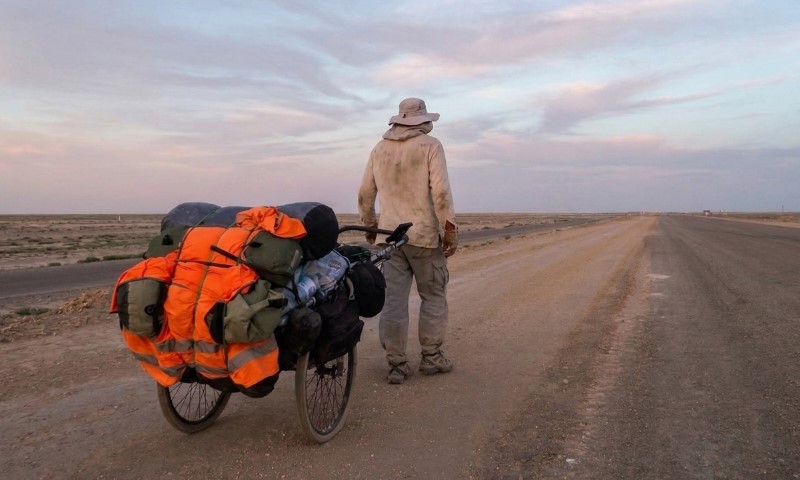
Hundreds of residents gathered to welcome him, watching as he pushed his battered equipment cart through the streets.
At his mother’s house, a banner reading “Welcome Home Son” marked the finish line. Angela Bushby embraced her son, whom she had not seen in roughly a decade.
For a man who had survived dangerous jungles, frozen seas, and years of immigration disputes, getting through the final few yards was unusually straightforward.
How a 12-Year Plan Turned Into 28 Years
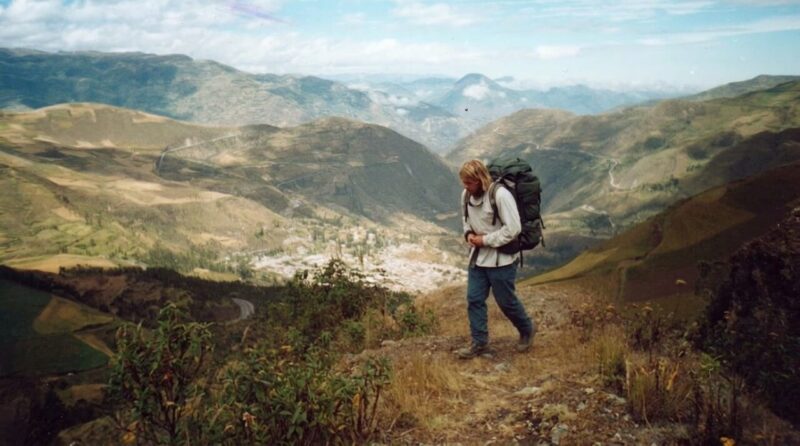
Karl Bushby’s Goliath Expedition began on November 1, 1998, in Punta Arenas, Chile. Aged 29, he intended to walk all the way back to England, completing a continuous route across the planet.
His inspiration came partly through his father, Keith, who had mentioned a debate among military personnel about the possibility of walking between continents using the Bering Strait.
Bushby decided to find out for himself.
Two rules governed his expedition. He would not use transportation to advance along his route, and he would not return home until the challenge was complete.
Flights could get him to his starting point, but once the expedition began, progress had to depend on his own physical effort.
That distinction eventually became important. Walking across continents was difficult enough, but oceans, international borders, and restricted territories created problems that ordinary long-distance hikers rarely encounter.
Bushby initially calculated that the distance might be covered in approximately five years, although he considered 12 years or more a realistic expectation.
Actual completion took 28 years and one day.
His expedition eventually covered approximately 31,000 miles, or 50,000 kilometers. Spread evenly across 28 years, that works out to roughly 1,107 miles annually. However, such an average hardly describes his actual progress, which included long periods when travel was impossible.
Weather, money, government decisions, and international conflicts repeatedly interrupted his plans. Walking was only one part of getting home.
Russia alone consumed nearly 10 years of the expedition. Bitter weather limited how much ground he could cover, while visa restrictions regularly stopped him altogether.
Walking across Siberia was difficult enough without having to arrange permission to continue every time the paperwork expired.
Jungles, Frozen Seas, and Government Paperwork
View this post on Instagram
Danger arrived early.
In 2001, Bushby crossed the Darién Gap between Colombia and Panama, a roadless region containing dense rainforest, mountains, and areas affected by armed conflict.
After surviving the crossing, he spent 18 days in custody for entering a restricted border zone in Panama.
Five years later came an even greater physical challenge.
In 2006, Bushby and American adventurer Dimitry Kieffer attempted to cross the Bering Strait between Alaska and Russia.
Covering approximately 56 miles across shifting sea ice required careful navigation, physical endurance, and considerable luck. Sections of ice broke apart, forcing dangerous encounters with freezing water.
At one point, their equipment nearly disappeared into the sea. They also encountered a polar bear.
After an initial attempt ended with an evacuation, the pair resumed their efforts and eventually completed the crossing.
Russian authorities were considerably less impressed with the achievement. Bushby and Kieffer were detained for entering the country without proper authorization.
Visa difficulties subsequently disrupted Bushby’s progress for years.
In 2012, after Russia denied him another visa, he walked between Los Angeles and the Russian Embassy in Washington, D.C., as a protest. His efforts eventually helped secure the documentation necessary to continue.
It was an unusual solution to an administrative problem, although walking several thousand miles had already become his preferred method of resolving difficulties.
Money caused additional delays. Sponsorship funding suffered during the 2008 financial crisis, while the COVID-19 pandemic later restricted international travel.
Russia’s invasion of Ukraine in 2022 complicated his planned route through Eastern Europe.
Rather than abandon his rules, Bushby found another option.
He swam across the Caspian Sea, completing the crossing over 31 days. It was an extraordinary physical undertaking, but it also demonstrated how seriously he treated the restrictions he had imposed on himself decades earlier.
By then, his greatest obstacle was often not the distance between two places. It was obtaining permission to travel between them.
The Final Miles Back to England
By October 2026, Bushby had reached the final major obstacle separating him and home: the English Channel.
Even Europe, comparatively close to home, presented another scheduling problem. Schengen immigration rules generally limit British short-term visitors to 90 days within 180 days.
Bushby therefore had to manage his progress around permitted stays rather than simply keep walking. After decades of border disputes, the final stretch still came with a calendar attached.
Ferries operate regularly between continental Europe and Britain, but taking one would have violated his expedition rules.
Bushby had also sought permission to walk through a Channel Tunnel service passage. When that option was rejected, he chose to swim.
After completing the crossing, he arrived on the English coast near Dover, where British immigration officers checked his passport.
Even after nearly three decades circling the planet, returning home still required the appropriate paperwork.
His father and brothers welcomed him at Dover before he continued north toward Hull.
On November 2, his hometown gave him a reception that was considerably more enthusiastic than any border inspection.
Hundreds gathered for a civic welcome in the city center. Residents followed his progress, taking photographs and cheering as he pushed his expedition cart through familiar streets.
Bushby thanked the people who had helped him during his travels, acknowledging that completing the expedition had required assistance across numerous countries.
After the public celebrations, he still had one destination left.
Angela Bushby was waiting outside her house.
Mother and son embraced while cameras recorded their reunion. Bushby responded with affectionate jokes, telling his emotional mother to compose herself.
Nearly three decades of effort had ended on an ordinary residential street, with neighbors, relatives, and reporters crowded around the front door.
The Hard Part Might Be Staying Put
Karl Bushby’s achievement required endurance, stubbornness, and help provided by people across the world. His original plans survived financial difficulties, international conflicts, immigration restrictions, and a global pandemic.
Yet his homecoming was ultimately a family occasion.
Hull welcomed a man who had completed an extraordinary expedition, but Angela Bushby was simply welcoming her son.
After 28 years, the distance that mattered most was the short walk between his equipment cart and her front door.
Bushby spent nearly three decades proving he could make his way around the world. Now that he is finally home, he faces something he has had considerably less practice at: staying in one place.